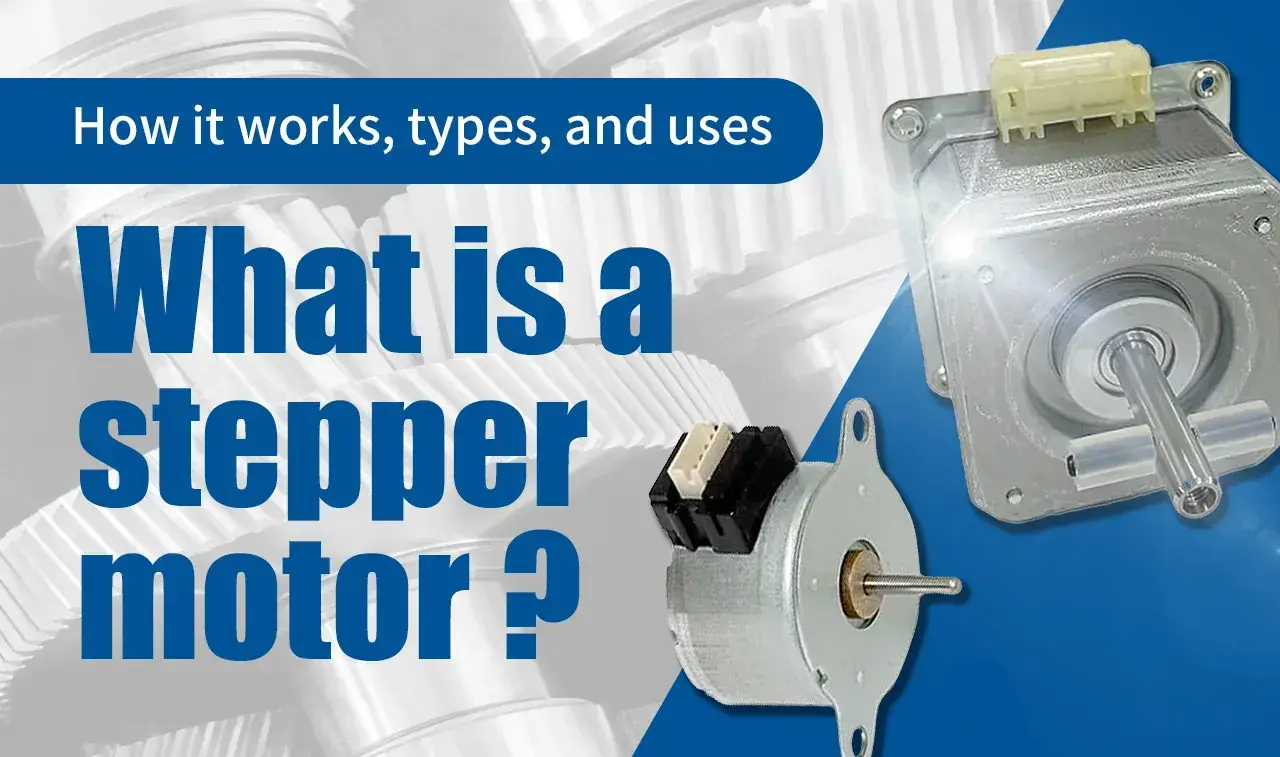
A stepper motor turns through a fixed angle each time it receives a pulse. It positions accurately under open-loop control, with no feedback sensor and a relatively simple control system.
That makes it a common choice wherever a mechanism has to move a set amount and stop: manufacturing equipment, medical devices, and robotics.
How a stepper motor works
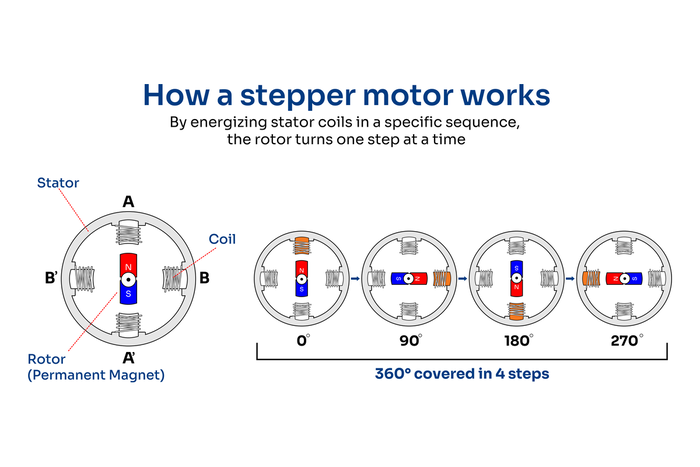 The driver energizes the stator coils in sequence. Each switch of the current moves the magnetic field forward one position, and the rotor turns one step angle to follow. Repeat the cycle and the pulse train becomes rotation.
- Coil excitation: current flows through one or more stator coils and sets up a magnetic field
- Magnetic alignment: the rotor, with its permanent magnets or iron teeth, pulls into line with that field and settles where the magnetic force is most stable.
- Sequential switching: the driver drops the current in one coil and raises it in the next, moving the field on to a new position.
- Stepped rotation: the rotor turns one step angle to line up with the new field. Repeat, and the steps add up to continuous rotation.
Key characteristics
Accurate positioning: rotation follows the pulse count, so position can be commanded without measuring it.
Open-loop control: position and speed are controlled without an encoder or other feedback sensor, which keeps the system relatively simple.
Two ideas explain most of the behavior below: step angle and control method.
Step angle
The step angle is how far the rotor turns on one pulse. The number of steps in a full 360° revolution is the resolution.
A 1.8° step angle takes 200 steps per revolution, so the resolution is 200 steps (360° ÷ 1.8°).
Resolution has a large effect on performance, cost, and the applications a motor suits.
Low-resolution motors (7.5°, for example)
A simpler structure keeps the cost down. Air-conditioner louvers and surveillance cameras are typical: the mechanism has to move and stop, but not to a tight tolerance.
High-resolution motors (1.8° or 0.9°, for example)
These tend to cost more than low-resolution types, but they offer finer positioning. 3D printers, medical devices, and semiconductor manufacturing equipment are the usual applications.
The step angle is fixed by the physical geometry of the rotor and stator, so it cannot be changed after the motor is built. Microstepping, covered below, subdivides each step in the driver instead, for smoother rotation and finer positioning.
Open-loop and closed-loop control
Most stepper motors run open loop: the motor follows the pulse train from the driver, and nothing measures the result. The system is relatively simple and inexpensive, but if the actual position drifts from the commanded position, nothing detects it and nothing corrects it.
That is why loss of synchronism, also called step loss, can occur. A load above the motor’s allowable torque, or sharp acceleration or deceleration, leaves the rotor unable to keep up with the pulses. The commanded and actual positions then diverge.
Where even a small error is unacceptable, an encoder closes the loop. Position is fed back continuously, so an error is corrected as it appears, and the system delivers reliable, high-precision positioning.
The three types of stepper motor
Stepper motors fall into three main types by structure. They differ in resolution, torque, and cost, and the choice usually comes down to which of the three matters most in the application.
Permanent magnet (PM) stepper motor
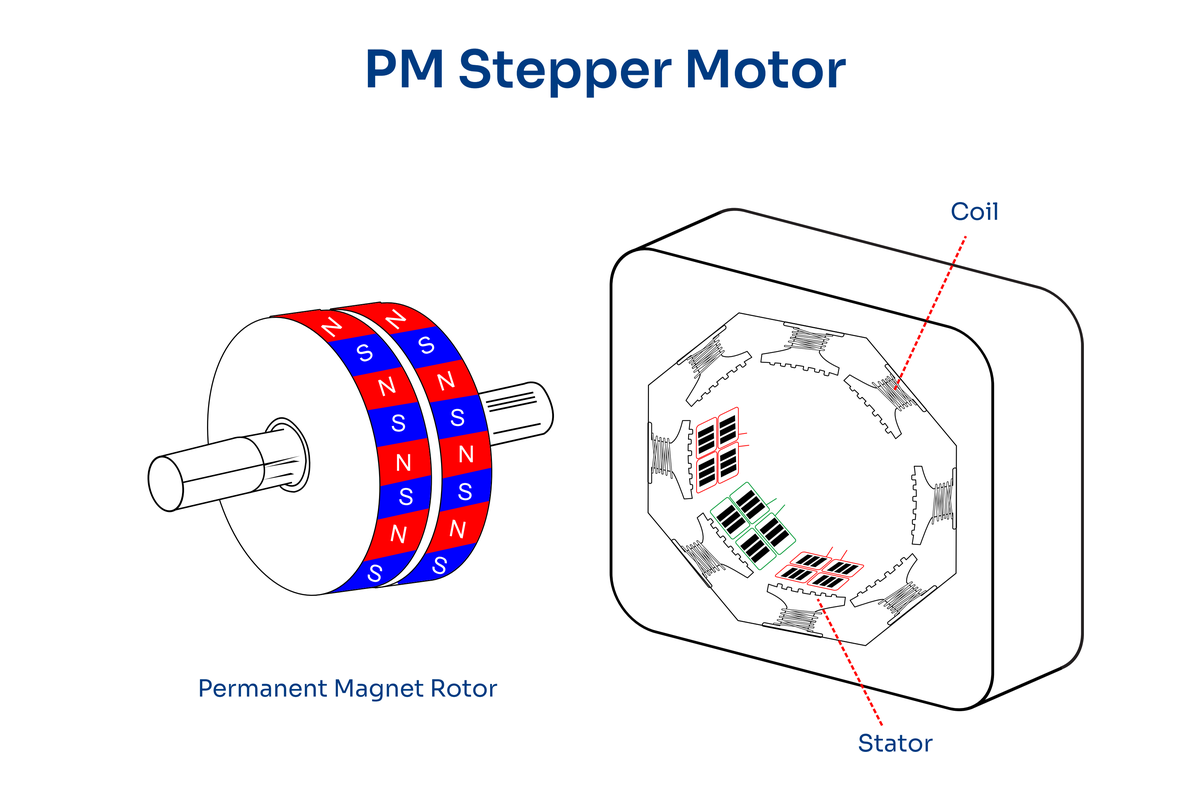 A permanent magnet (PM) stepper motor carries magnets on the rotor. The rotor is pulled directly by the stator field, which gives it relatively high torque.
The simple construction helps keep manufacturing cost down, which is why PM types are common in consumer equipment: printers, scanners, and game consoles.
The number of rotor poles is limited, so the step angle is typically 7.5–15°. That is coarser than a hybrid type, but it is enough wherever the mechanism does not need tight positioning.
Variable reluctance (VR) stepper motor
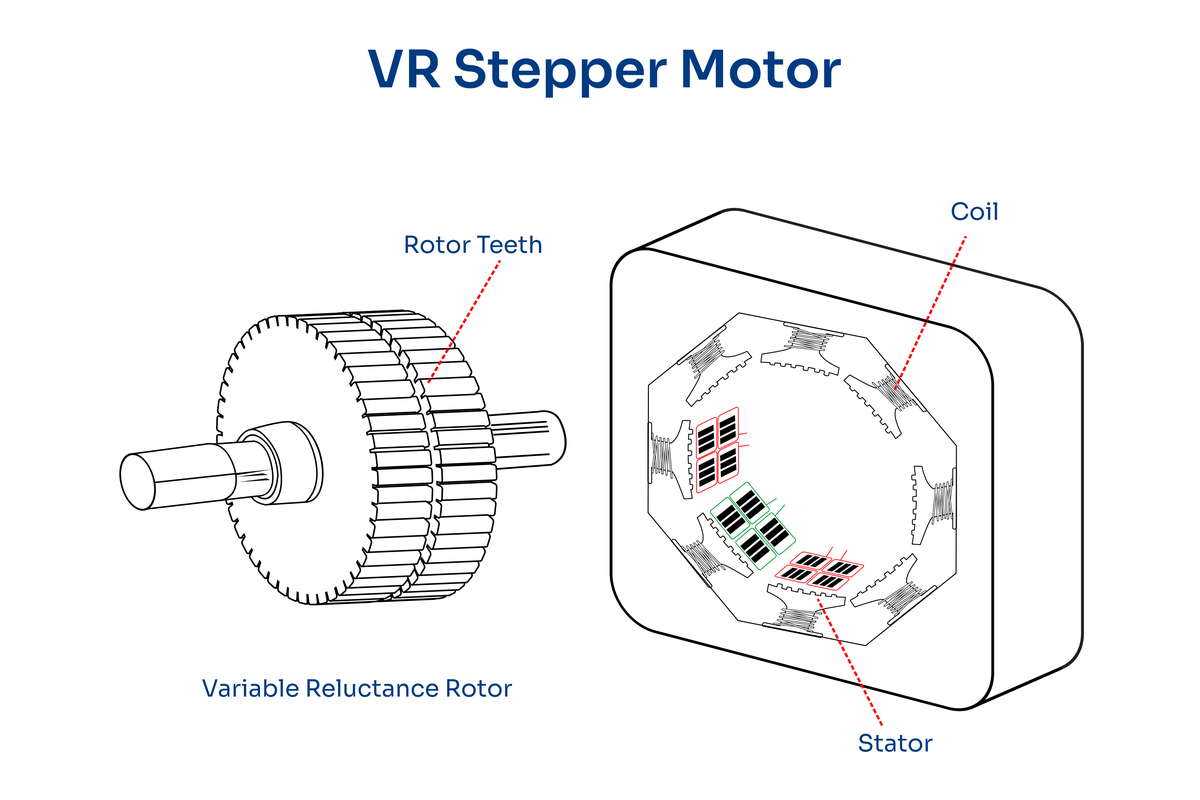 A variable reluctance (VR) stepper motor replaces the rotor magnets with a toothed iron core. Fine teeth on the rotor and stator allow a relatively small step angle and relatively high resolution, and the magnet-free rotor has a low moment of inertia, so it responds quickly.
With no magnets, there is no detent torque to hold the rotor when the coils are off, and it produces less torque than a PM or HB type. Holding position means keeping current flowing, so power consumption tends to be higher.
Hybrid types offer high resolution and high torque together, so VR types are now used in only a limited range of applications.
Hybrid (HB) stepper motor
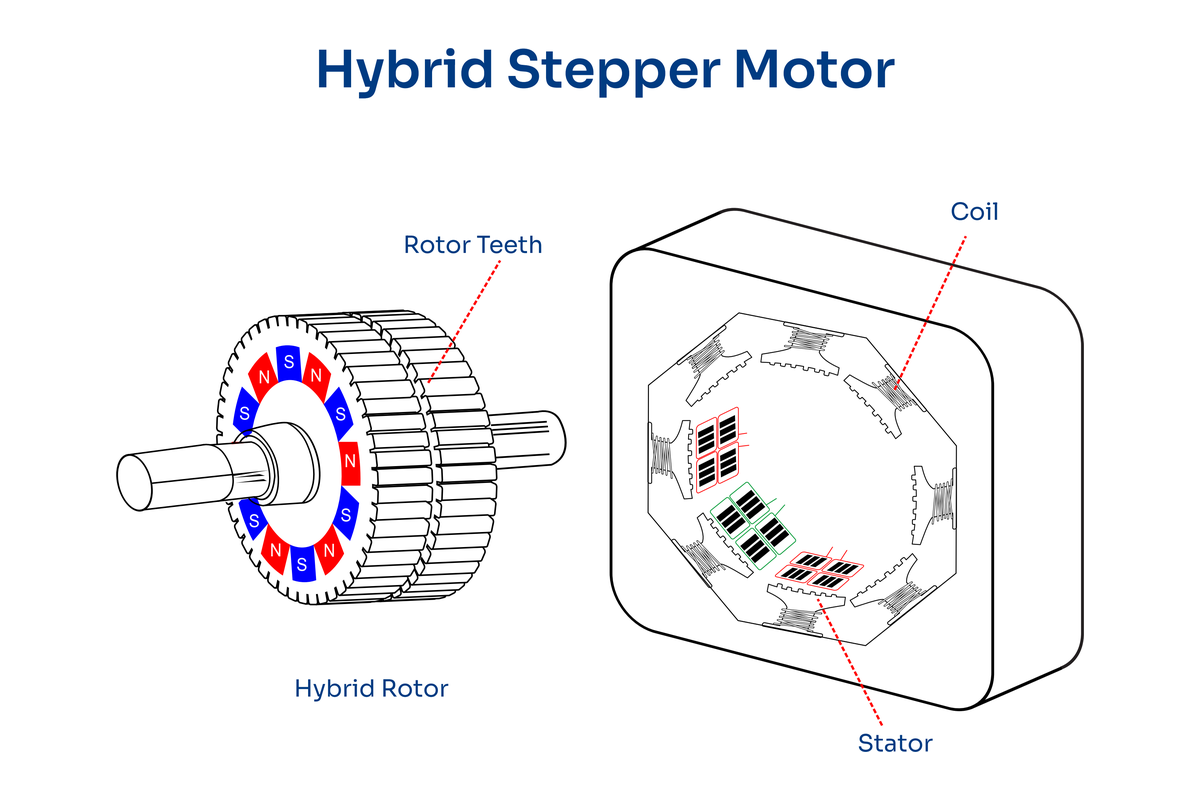 A hybrid (HB) stepper motor combines the PM and VR types. Magnets sit inside the rotor with toothed iron cores on either side, offset by half a tooth pitch, and the stator is toothed as well. That geometry is what produces the high resolution.
Step angles of 1.8° and 0.9° are standard, the finest of the three types. The magnetic circuit is efficient as well, so an HB motor produces more torque than a PM or VR type of the same frame size.
The complex structure makes an HB motor relatively expensive, and larger and heavier as well. In exchange it delivers resolution and torque together, which is why the HB type is now the mainstream choice for industrial equipment that needs high positioning accuracy: 3D printers, Computer Numerical Control (CNC) machine tools, pick-and-place machines, and semiconductor manufacturing equipment.
Comparison
|
PM |
VR |
HB |
|
|
Resolution |
★ |
★★ |
★★★ |
|
Torque |
★★ |
★ |
★★★ |
|
Cost |
★★★ |
★★ |
★ |
Drive methods and excitation modes
Resolution, torque, and vibration all change with the drive method and the excitation mode. The choice matters as much as the choice of motor type.
Drive method
The drive method sets which direction current flows through the coils.
Unipolar drive
Unipolar drive sends current through each coil in one direction only. The circuit is simple, which makes it easy to control and inexpensive to build.
Only part of each coil is used, so the torque tends to be lower than with bipolar drive. That suits applications where torque is not the limiting factor.
Bipolar drive
Bipolar drive uses the whole coil and reverses the current direction. Using all of the copper makes it easier to get high torque from the same motor.
It also pairs well with microstepping, covered below, for fine positioning and smooth rotation. That combination is why bipolar drive is widely used in industrial stepper motors today.
Excitation mode
The excitation mode sets the order in which the coils are energized.
Full-step drive
Full-step drive comes in two forms: 1-phase on and 2-phase on excitation.
With 1-phase on excitation, one phase is energized at a time. Power consumption stays low, but the torque is relatively small.
With 2-phase on excitation, two phases are energized at once. That produces more torque than 1-phase on excitation and draws more power.
Both step by a fixed angle, which keeps the control simple. Both also tend to vibrate more and run louder than half-step drive or microstepping.
Half-step drive
Half-step drive, or 1-2 phase on excitation, alternates between one and two energized phases, moving the rotor half a step at a time. That doubles the resolution of full-step drive, for smoother rotation and finer positioning.
The alternation produces torque ripple, and the control is a little more involved.
Microstepping
Microstepping controls the current level rather than switching it on and off, so the rotor can hold positions between the nominal steps.
Resolution rises without any change to the motor itself, vibration and noise fall, and the rotation is smoother. Common settings include 1/4, 1/8, 1/16, and 1/32 step.
The driver has to regulate current precisely, which adds circuit complexity and cost. Resolution is not accuracy: a finer microstep setting does not improve positioning accuracy in proportion.
Where stepper motors are used
Because the pulse signal controls the rotation angle and the amount of rotation, stepper motors are used in a wide range of equipment that needs positioning or metered feed.
Manufacturing and factory automation
CNC mills and lathes: axis positioning and tool head movement
3D printers (FDM and FFF): filament feed to the extruder and X-, Y-, and Z-axis control
Pick-and-place machines: component placement on PCB assembly lines
Packaging machinery: label application, conveyor indexing, and fill volume control
Medical and analytical instruments
Syringe and infusion pumps: precise delivery of drug solutions and reagents
Automated pipetting systems: sample handling in clinical analyzers
Medical imaging equipment: driving the positioning mechanisms in CT and MRI scanners
Consumer equipment
Inkjet and laser printers: paper feed and print head positioning
Document scanners: driving the sensor unit and the paper feed mechanism
Camera systems: autofocus and pan-tilt-zoom (PTZ) control
Robotics and material handling
Industrial and service robots: joint and end-effector positioning
Automated guided vehicles (AGVs) and autonomous mobile robots (AMRs): position control for steering and actuators
Telescope and antenna mounts: precise angle control and tracking
Summary
A stepper motor turns a fixed angle per pulse, which makes position and travel easy to control. That is why it appears across manufacturing equipment, medical devices, and robotics.
A stepper motor turns a fixed angle per pulse, which makes position and travel easy to control. That is why it appears across manufacturing equipment, medical devices, and robotics.
Choosing the right type and control method for the application makes the required motion control achievable.
The Mabuchi Motor Group supplies stepper motors for a wide range of applications. Send us your application and target specifications, and we will propose a suitable product.
[Contact Us]
Product page: [Stepper Motors | Mabuchi Micro Tech Products]
FAQs
Can a stepper motor run continuously?
Yes, within limits. A stepper motor supports continuous running but is built for accurate position control, so where continuous rotation is the main purpose, increased heat and reduced efficiency can become issues. For long runs at medium to high speed, a brushless DC motor is the usual choice.
How do you prevent loss of synchronism in open-loop control?
Size the motor with margin: 2–2.5 times the required torque is the usual guide. Ramp acceleration and deceleration rather than commanding step changes, and use microstepping to keep vibration and resonance down. Where reliability matters most, consider closing the loop with an encoder.